| Description |
The Human Interleukin 26 (IL-26) ELISA Kit quantitates IL-26 levels in human serum, urine, tissue homogenates, cell lysates, or cell culture supernates. IL-26, a cytokine primarily secreted by Th1 and Th17 cells, belongs to the IL-20 cytokine subfamily. It displays antimicrobial activity. IL-26 also signals through the IL-10R2/IL-20R1 heterodimeric receptor to activate cells via STAT3 phosphorylation. Acting as a potent chemoattractant for neutrophils, IL-26 drives inflammation and activates neutrophils to release inflammatory cytokines, proteases, and antimicrobial peptides. In addition to being a driver of inflammation, IL-26 may also act as an effector of inflammation, leading to the establishment of a deleterious amplification loop and ultimately sustained inflammation.
This kit employs the sandwich-ELISA mechanism in conjugation with IL-26 antibody-IL-26 antigen-specific binding as well as HRP-TMB chromogenic reaction to measure the concentrations of IL-26 in the samples. The kit is characterized by high sensitivity, strong specificity, good linearity, recovery of 93%-107%, precision less than 10%, and lot-to-lot consistency. Refer to the product instructions for more validation information.
|
| Target Name |
Interleukin 26,IL-26 |
| Alternative Names |
AK155 ELISA Kit; IL 26 ELISA Kit; IL-26 ELISA Kit; IL26 ELISA Kit; IL26_HUMAN ELISA Kit; Interleukin 26 ELISA Kit; Interleukin-26 ELISA Kit; Protein AK155 ELISA Kit |
| Abbreviation |
IL26 |
| Species |
Homo sapiens (Human) |
| Sample Types |
serum, urine, tissue homogenates, cell lysates, cell culture supernates |
| Detection Range |
62.5 pg/mL-4000 pg/mL |
| Sensitivity |
15.6 pg/mL |
| Assay Time |
1-5h |
| Sample Volume |
50-100ul |
| Detection Wavelength |
450 nm |
| Research Area |
Immunology |
| Assay Principle |
quantitative |
| Measurement |
Sandwich |
| Precision |
| Intra-assay Precision (Precision within an assay): CV% |
| Three samples of known concentration were tested twenty times on one plate to assess. |
|
| Inter-assay Precision (Precision between assays): CV% |
| Three samples of known concentration were tested in twenty assays to assess. |
|
|
| |
|
|
|
|
|
|
|
| Linearity |
| To assess the linearity of the assay, samples were spiked with high concentrations of human IL-26 in various matrices and diluted with the Sample Diluent to produce samples with values within the dynamic range of the assay. |
| |
Sample |
Serum(n=4) |
|
| 1:1 |
Average % |
96 |
|
| Range % |
90-102 |
|
| 1:2 |
Average % |
89 |
|
| Range % |
84-95 |
|
| 1:4 |
Average % |
100 |
|
| Range % |
95-106 |
|
| 1:8 |
Average % |
97 |
|
| Range % |
92-104 |
|
|
| Recovery |
| The recovery of human IL-26 spiked to levels throughout the range of the assay in various matrices was evaluated. Samples were diluted prior to assay as directed in the Sample Preparation section. |
| Sample Type |
Average % Recovery |
Range |
|
| Serum (n=5) |
89 |
93-96 |
|
| EDTA plasma (n=4) |
102 |
98-107 |
|
| |
|
|
|
|
|
|
| |
|
|
|
|
|
|
|
| Typical Data |
| These standard curves are provided for demonstration only. A standard curve should be generated for each set of samples assayed. |
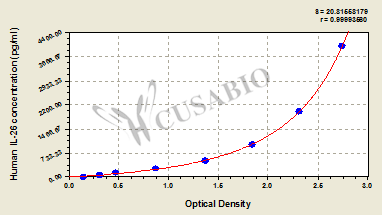
| pg/ml |
OD1 |
OD2 |
Average |
Corrected |
|
| 4000 |
2.749 |
2.798 |
2.774 |
2.616 |
|
| 2000 |
2.315 |
2.364 |
2.340 |
2.182 |
|
| 1000 |
1.843 |
1.889 |
1.866 |
1.708 |
|
| 500 |
1.399 |
1.381 |
1.390 |
1.232 |
|
| 250 |
0.899 |
0.888 |
0.894 |
0.736 |
|
| 125 |
0.483 |
0.487 |
0.485 |
0.327 |
|
| 62.5 |
0.316 |
0.329 |
0.323 |
0.165 |
|
| 0 |
0.157 |
0.159 |
0.158 |
|
|
|
|
| Materials provided |
- A micro ELISA plate --- The 96-well plate has been pre-coated with an anti-human IL-26 antibody. This dismountable microplate can be divided into 12 x 8 strip plates.
- Two vials lyophilized standard --- Dilute a bottle of the standard at dilution series, read the OD values, and then draw a standard curve.
- One vial Biotin-labeled IL-26 antibody (100 x concentrate) (120 μl/bottle) ---Act as the detection antibody.
- One vial HRP-avidin (100 x concentrate) (120 μl/bottle) --- Bind to the detection antibody and react with the TMB substrate to make the solution chromogenic.
- One vial Biotin-antibody Diluent (15 ml/bottle) ---Dilute the Biotin-antibody solution.
- One vial HRP-avidin Diluent (15 ml/bottle) ---Dilute the HRP-avidin solution.
- One vial Sample Diluent (50 ml/bottle)---Dilute the sample to an appropriate concentration.
- One vial Wash Buffer (25 x concentrate) (20 ml/bottle) --- Wash away unbound or free substances.
- One vial TMB Substrate (10 ml/bottle) --- Act as the chromogenic agent. TMB interacts with HRP, eliciting the solution turns blue.
- One vial Stop Solution (10 ml/bottle) --- Stop the color reaction. The solution color immediately turns from blue to yellow.
- Four Adhesive Strips (For 96 wells) --- Cover the microplate when incubation.
- An instruction manual
|
| Materials not provided |
- A microplate reader capable of measuring absorbance at 450 nm, with the correction wavelength set at 540 nm or 570 nm.
- An incubator that can provide stable incubation conditions up to 37°C±5°C.
- Squirt bottle, manifold dispenser, or automated microplate washer.
- Absorbent paper for blotting the microtiter plate.
- 100ml and 500ml graduated cylinders.
- Deionized or distilled water.
- Adjustable pipettes to measure volumes ranging from 2 µL to 1 mL and pipette tips.
- Timer
- Test tubes for dilution.
|
| Storage |
Store at 2-8°C. Please refer to protocol. |
| Lead Time |
3-5 working days |

