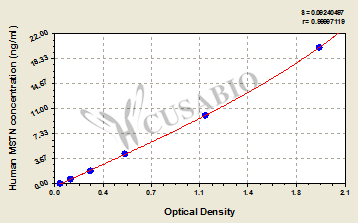
The Human Myostatin (MSTN) ELISA kit is specifically designed and validated to quantitatively detect the levels of MSTN in the serum, plasma, or tissue homogenates. It is not intended for diagnostic use. This assay kit was designed and optimized for signal transduction research use in humans. It has undergone rigorous quality control in multiple parameters, including sensitivity, specificity, precision, linearity, recovery, and inter-batch difference. Refer to the product instructions for more details.
This assay is based on the Sandwich-ELISA mechanism (the MSTN in the sample is sandwiched between the pre-coated MSTN antibody and HRP-labeled MSTN antibody) and enzyme-substrate chromogenic reaction. The color intensity is positively related to the amount of MSTN bound in the initial step. The levels of MSTN in the samples can be determined by referring to the O.D. (optical density) of the samples to the standard curve.
MSTN, also called growth and differentiation factor-8, is a potent negative regulator of skeletal muscle growth in mammals. It plays an important role in skeletal muscle homeostasis. MSTN can induce muscle atrophy by inhibiting myoblast proliferation, increasing ubiquitin-proteasomal activity, and downregulating the activity of the IGF-Akt pathway. In muscle progenitors and myoblasts, MSTN mainly functions to suppress self-renewal and differentiation. In addition to exerting functions in muscle, MSTN also functions in other tissues like adipose tissue. MSTN mainly inhibits adipogenesis in preadipocytes, whereas it can promote the adipogenesis of pluripotent stem cells.