| Description |
The Human Pulmonary surfactant-associated protein A (SP-A) ELISA kit is a solid-phase immunoassay specially designed to qualitatively measure human SP-A in serum, plasma, cell culture supernates, or urine. It is based on the Sandwich-ELISA mechanism. SP-A in the sample is bound to the capture antibody immobilized on the 96-well strip plate and then sandwiched with the biotinylated SP-A antibody. After the addition of HRP-avidin and TMB substrate, the solution in the wells turns blue. The color reaction is stopped by adding the stop solution into the wells, and the color changes from blue to yellow. The color intensity is positively proportional to the SP-A bound in the initial step. The SP-A concentration can be calculated according to the standard curve. This kit is tested with high sensitivity, strong specificity, good linearity, precision less than 10%, recovery with 89%-100%, and lot-to-lot consistency. More validation information is described in the product instructions.
SP-A is a hydrophilic calcium-dependent (C-type) lectin primarily synthesized and secreted by the alveolar epithelial type II cells of the lung, as part of the pulmonary surfactant. It is involved in the maintenance of pulmonary tissue homeostasis by reducing the surface tension of fluids that coat the lung. SP-A binds different pathogens such as viruses, bacteria, fungi, and the nematode Schistosoma mansoni, via their carbohydrate recognition domains (CRDs), and act as opsonins to trigger the host’s innate immune response. In some cases, SP-A displays its own microbicidal activity by increasing the permeability of the pathogen cellular membrane. Overall, SP-A opsonized-microorganisms enhances their attachment to phagocytic cells, with subsequent pathogen clearance. Additionally, SP-A has also been demonstrated to participate in the control of pulmonary inflammation including allergy and asthma.
|
| Target Name |
Pulmonary surfactant-associated protein A1 |
| Alternative Names |
35 kDa pulmonary surfactant associated protein ELISA Kit; 35 kDa pulmonary surfactant-associated protein ELISA Kit; Alveolar proteinosis protein ELISA Kit; COLEC4 ELISA Kit; Collectin 4 ELISA Kit; Collectin-4 ELISA Kit; FLJ50593 ELISA Kit; FLJ51913 ELISA Kit; FLJ61144 ELISA Kit; FLJ77898, ELISA Kit; FLJ79095 ELISA Kit; FLJ99559 ELISA Kit; MGC133365 ELISA Kit; MGC198590 ELISA Kit; OTTHUMP00000019928 ELISA Kit; OTTHUMP00000019929 ELISA Kit; OTTHUMP00000019930 ELISA Kit; OTTHUMP00000019931 ELISA Kit; PSAP ELISA Kit; PSP A ELISA Kit; PSP-A ELISA Kit; PSPA ELISA Kit; pulmonary surfactant -associated protein, 35-KD ELISA Kit; pulmonary surfactant apoprotein PSP-A ELISA Kit; pulmonary surfactant associated protein A1 ELISA Kit; Pulmonary surfactant-associated protein A1 ELISA Kit; SFTA1_HUMAN ELISA Kit; SFTP1 ELISA Kit; SFTPA1 ELISA Kit; SFTPA1B ELISA Kit; SP A ELISA Kit; SP A1 ELISA Kit; SP-A ELISA Kit; SP-A1 ELISA Kit; SPA ELISA Kit; SPA1 ELISA Kit; surfactant protein A1 ELISA Kit; surfactant protein A1 variant AB'D' 6A2 ELISA Kit; surfactant protein A1 variant AB'D' 6A3 ELISA Kit; surfactant protein A1 variant AB'D' 6A4 ELISA Kit; surfactant protein A1 variant ACD' 6A2 ELISA Kit; surfactant protein A1 variant ACD' 6A3 ELISA Kit; surfactant protein A1 variant ACD' 6A4 ELISA Kit; surfactant protein A1 variant AD' 6A ELISA Kit; surfactant protein A1 variant AD' 6A2 ELISA Kit; surfactant protein A1 variant AD' 6A3 ELISA Kit; surfactant protein A1 variant AD' 6A4 ELISA Kit; surfactant protein A1B ELISA Kit; surfactant, pulmonary associated protein A1A ELISA Kit; surfactant, pulmonary associated protein A1B ELISA Kit; surfactant-associated protein, pulmonary 1 ELISA Kit |
| Abbreviation |
SFTPA1 |
| Species |
Homo sapiens (Human) |
| Sample Types |
serum, plasma, cell culture supernates, urine |
| Detection Range |
15.6 pg/mL-1000pg/mL |
| Sensitivity |
3.9 pg/mL |
| Assay Time |
1-5h |
| Sample Volume |
50-100ul |
| Detection Wavelength |
450 nm |
| Research Area |
Signal Transduction |
| Assay Principle |
quantitative |
| Measurement |
Sandwich |
| Precision |
| Intra-assay Precision (Precision within an assay): CV% |
| Three samples of known concentration were tested twenty times on one plate to assess. |
|
| Inter-assay Precision (Precision between assays): CV% |
| Three samples of known concentration were tested in twenty assays to assess. |
|
|
| |
|
|
|
|
|
|
|
| Linearity |
| To assess the linearity of the assay, samples were spiked with high concentrations of human SP-A in various matrices and diluted with the Sample Diluent to produce samples with values within the dynamic range of the assay. |
| |
Sample |
Serum(n=4) |
|
| 1:100 |
Average % |
86 |
|
| Range % |
80-92 |
|
| 1:200 |
Average % |
97 |
|
| Range % |
91-105 |
|
| 1:400 |
Average % |
99 |
|
| Range % |
92-110 |
|
| 1:800 |
Average % |
93 |
|
| Range % |
86-98 |
|
|
| Recovery |
| The recovery of human SP-A spiked to levels throughout the range of the assay in various matrices was evaluated. Samples were diluted prior to assay as directed in the Sample Preparation section. |
| Sample Type |
Average % Recovery |
Range |
|
| Serum (n=5) |
93 |
89-98 |
|
| EDTA plasma (n=4) |
97 |
90-100 |
|
| |
|
|
|
|
|
|
| |
|
|
|
|
|
|
|
| Typical Data |
| These standard curves are provided for demonstration only. A standard curve should be generated for each set of samples assayed. |
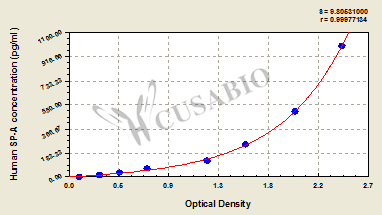
| pg/ml |
OD1 |
OD2 |
Average |
Corrected |
|
| 1000 |
2.420 |
2.418 |
2.419 |
2.318 |
|
| 500 |
2.008 |
1.999 |
2.004 |
1.903 |
|
| 250 |
1.582 |
1.555 |
1.569 |
1.468 |
|
| 125 |
1.248 |
1.211 |
1.230 |
1.129 |
|
| 62.5 |
0.709 |
0.689 |
0.699 |
0.598 |
|
| 31.25 |
0.472 |
0.436 |
0.454 |
0.353 |
|
| 15.6 |
0.290 |
0.269 |
0.280 |
0.179 |
|
| 0 |
0.104 |
0.098 |
0.101 |
|
|
|
|
| Materials provided |
- A micro ELISA plate ---The 96-well plate has been pre-coated with an anti-human SP-A antibody. This dismountable microplate can be divided into 12 x 8 strip plates.
- Two vials lyophilized standard ---Dilute a bottle of the standard at dilution series, read the OD values, and then draw a standard curve.
- One vial Biotin-labeled SP-A antibody (100 x concentrate) (120 μl/bottle) ---Act as the detection antibody.
- One vial HRP-avidin (100 x concentrate) (120 μl/bottle) ---Bind to the detection antibody and react with the TMB substrate to make the solution chromogenic.
- One vial Biotin-antibody Diluent (15 ml/bottle) ---Dilute the Biotin-antibody.
- One vial HRP-avidin Diluent (15 ml/bottle) ---Dilute the HRP-avidin solution.
- One vial Sample Diluent (50 ml/bottle)---Dilute the sample to an appropriate concentration.
- One vial Wash Buffer (25 x concentrate) (20 ml/bottle) ---Wash away unbound or free substances.
- One vial TMB Substrate (10 ml/bottle) ---Act as the chromogenic agent. TMB interacts with HRP, eliciting the solution turns blue.
- One vial Stop Solution (10 ml/bottle) ---Stop the color reaction. The solution color immediately turns from blue to yellow.
- Four Adhesive Strips (For 96 wells) --- Cover the microplate when incubation.
- An instruction manual
|
| Materials not provided |
- A microplate reader capable of measuring absorbance at 450 nm, with the correction wavelength set at 540 nm or 570 nm.
- An incubator can provide stable incubation conditions up to 37°C±5°C.
- Centrifuge
- Vortex
- Squirt bottle, manifold dispenser, or automated microplate washer
- Absorbent paper for blotting the microtiter plate
- 50-300ul multi-channel micropipette
- Pipette tips
- Single-channel micropipette with different ranges
- 100ml and 500ml graduated cylinders
- Deionized or distilled water
- Timer
- Test tubes for dilution
|
| Storage |
Store at 2-8°C. Please refer to protocol. |
| Lead Time |
3-5 working days |

