Rat placenta growth factor,PLGF ELISA kit
Product Details
| Description |
The Rat placenta growth factor(PLGF)ELISA Kit allows for the in vitro quantitative determination of PLGF concentrations in serum, plasma, or tissue homogenates. The detection mechanism of this kit is based on the Sandwich-ELISA technique. PLGFin the sample is bound to the anti-rat PLGFantibody immobilized on the microtiter plate and then sandwiched with a Biotin-labeled PLGFantibody. The solution color develops into blue after the ordinal addition of HRP-avidin and TMB. The color development is terminated after adding the stop solution, and the color turns from blue to yellow. The color intensity is positively correlated with PLGFcontent in the sample.
This kit exclusively recognizes rat PLGF. The kit has been quality controlled with high sensitivity, strong specificity, good linearity, precision less than 10%, recovery with 89%-98%, and high lot-to-lot consistency. Refer to the product manual for more information.
PLGF is a member of the VEGF (vascular endothelial growth factor) family and is mainly expressed in the placenta. It is a crucial molecule in angiogenesis and vasculogenesis, in particular during embryogenesis. Specifically, PLGF plays a role in trophoblast growth and differentiation. In human atherosclerotic lesions, PLGF expression is linked to plaque inflammation and neovascular growth. PLGF is also a potential biomarker for pre-eclampsia, a pregnancy complication characterized by hypertension and proteinuria in pregnancy.
|
| Target Name |
placental growth factor |
| Alternative Names |
Pgf ELISA Kit; Plgf ELISA Kit; Placenta growth factor ELISA Kit; PlGF ELISA Kit |
| Abbreviation |
PGF |
| Species |
Rattus norvegicus (Rat) |
| Sample Types |
serum, plasma, tissue homogenates |
| Detection Range |
3.12 pg/mL-200 pg/mL |
| Sensitivity |
0.78 pg/mL |
| Assay Time |
1-5h |
| Sample Volume |
50-100ul |
| Detection Wavelength |
450 nm |
| Research Area |
Cancer |
| Assay Principle |
quantitative |
| Measurement |
Sandwich |
| Precision |
| Intra-assay Precision (Precision within an assay): CV% |
| Three samples of known concentration were tested twenty times on one plate to assess. |
|
| Inter-assay Precision (Precision between assays): CV% |
| Three samples of known concentration were tested in twenty assays to assess. |
|
|
| |
|
|
|
|
|
|
|
| Linearity |
| To assess the linearity of the assay, samples were spiked with high concentrations of rat PLGF in various matrices and diluted with the Sample Diluent to produce samples with values within the dynamic range of the assay. |
| |
Sample |
Serum(n=4) |
|
| 1:1 |
Average % |
92 |
|
| Range % |
88-95 |
|
| 1:2 |
Average % |
94 |
|
| Range % |
89-98 |
|
| 1:4 |
Average % |
93 |
|
| Range % |
87-97 |
|
| 1:8 |
Average % |
99 |
|
| Range % |
93-102 |
|
|
| Recovery |
| The recovery of rat PLGF spiked to levels throughout the range of the assay in various matrices was evaluated. Samples were diluted prior to assay as directed in the Sample Preparation section. |
| Sample Type |
Average % Recovery |
Range |
|
| Serum (n=5) |
93 |
89-97 |
|
| EDTA plasma (n=4) |
94 |
91-98 |
|
| |
|
|
|
|
|
|
| |
|
|
|
|
|
|
|
| Typical Data |
| These standard curves are provided for demonstration only. A standard curve should be generated for each set of samples assayed. |
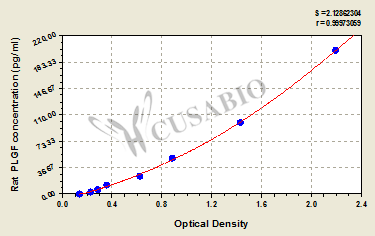
| pg/ml |
OD1 |
OD2 |
Average |
Corrected |
|
| 200 |
2.246 |
2.234 |
2.240 |
2.085 |
|
| 100 |
1.472 |
1.456 |
1.464 |
1.309 |
|
| 50 |
0.901 |
0.914 |
0.908 |
0.753 |
|
| 25 |
0.639 |
0.649 |
0.644 |
0.489 |
|
| 12.5 |
0.364 |
0.389 |
0.377 |
0.222 |
|
| 6.25 |
0.300 |
0.308 |
0.304 |
0.149 |
|
| 3.12 |
0.252 |
0.242 |
0.247 |
0.092 |
|
| 0 |
0.156 |
0.154 |
0.155 |
|
|
|
|
| Materials provided |
- A micro ELISA plate --The 96-well plate has been pre-coated with an anti-rat PLGF antibody. This dismountable microplate can be divided into 12 x 8 strip plates.
- Two vials lyophilized standard --Dilute a bottle of the standard at dilution series, read the OD values, and then draw a standard curve.
- One vial Biotin-labeled PLGF antibody (100 x concentrate) (120 μl/bottle) --Act as the detection antibody.
- One vial HRP-avidin (100 x concentrate) (120 μl/bottle) --Bind to the detection antibody and react with the TMB substrate to make the solution chromogenic.
- One vial Biotin-antibody Diluent (15 ml/bottle) --Dilute the high concentration Biotin-antibody to an appropriate working solution.
- One vial HRP-avidin Diluent (15 ml/bottle) --Dilute the high concentration HRP-avidin solution to an appropriate solution.
- One vial Sample Diluent (50 ml/bottle)--Dilute the sample to an appropriate concentration.
- One vial Wash Buffer (25 x concentrate) (20 ml/bottle) --- Wash away unbound or free substances.
- One vial TMB Substrate (10 ml/bottle) --Act as the chromogenic agent. TMB interacts with HRP, eliciting the solution turns blue.
- One vial Stop Solution (10 ml/bottle) --Stop the color reaction. The solution color immediately turns from blue to yellow.
- Four Adhesive Strips (For 96 wells) --Cover the microplate when incubation.
- An instruction manual
|
| Materials not provided |
- A microplate reader capable of measuring absorbance at 450 nm, with the correction wavelength set at 540 nm or 570 nm.
- An incubator can provide stable incubation conditions up to 37°C±5°C.
- Centrifuge
- Vortex
- Squirt bottle, manifold dispenser, or automated microplate washer
- Absorbent paper for blotting the microtiter plate
- 50-300ul multi-channel micropipette
- Pipette tips
- Single-channel micropipette with different ranges
- 100ml and 500ml graduated cylinders
- Deionized or distilled water
- Timer
- Test tubes for dilution
|
| Storage |
Store at 2-8°C. Please refer to protocol. |
| Lead Time |
3-5 working days |

